
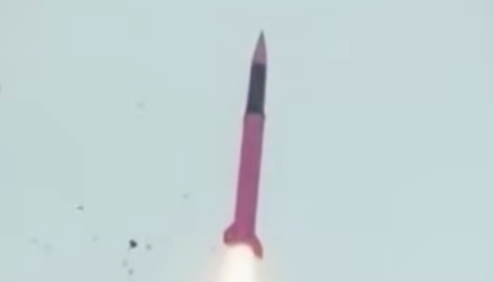
Fire Point Unveils Test Footage of Ukrainian Interceptor Missile Designed to Counter Ballistic Threats
Ukrainian defense technology company Fire Point has released compelling video footage showcasing the testing of their FP-7.X interceptor missile, marking a significant milestone in Ukraine’s domestic efforts to develop advanced air defense capabilities. The footage, published by Fire Point’s Chief Technology Officer Terekh, demonstrates the ongoing progress in creating a homegrown solution to counter the persistent ballistic missile threats that have plagued the country since the beginning of Russia’s full-scale invasion in February 2022.
The FP-7.X represents Ukraine’s ambitious push to reduce its dependence on Western-supplied air defense systems while simultaneously expanding its protective umbrella against incoming threats. As the war continues into its third year, Ukraine has faced relentless aerial attacks from Russian forces employing a diverse arsenal of cruise missiles, ballistic missiles, and Iranian-designed Shahed drones. The development of indigenous interceptor technology has become a strategic priority for Ukrainian defense planners seeking long-term solutions to protect critical infrastructure and civilian population centers.
Fire Point, a relatively young but rapidly growing Ukrainian defense startup, has positioned itself at the forefront of the country’s burgeoning military-industrial complex. The company emerged as part of a broader wave of private defense enterprises that have flourished since 2022, filling crucial gaps in Ukraine’s military capabilities. The release of the FP-7.X test footage signals that Ukrainian engineers are making tangible progress in mastering the complex technologies required for ballistic missile interception, a capability previously limited to a handful of technologically advanced nations including the United States, Israel, and Russia.
Intercepting ballistic missiles presents extraordinary technical challenges that have historically required decades of research and billions of dollars in investment. Unlike cruise missiles that fly at relatively constant altitudes and speeds, ballistic missiles follow high-arcing trajectories and can reach terminal velocities exceeding Mach 10 as they plunge toward their targets. Successfully neutralizing such threats demands sophisticated radar systems capable of detecting and tracking incoming projectiles, powerful computers to calculate interception solutions in fractions of a second, and highly maneuverable kill vehicles that can achieve precise hits. The fact that a Ukrainian company is actively testing such technology speaks to the remarkable acceleration of the country’s defense innovation ecosystem under wartime conditions.
The timing of this announcement carries significant strategic implications. Ukraine currently relies heavily on Western-provided systems such as the American Patriot PAC-3 and German IRIS-T for its air defense needs. While these systems have proven highly effective, their limited availability and the complex logistics of ammunition resupply have created persistent vulnerabilities. A domestically produced interceptor could potentially be manufactured in greater quantities within Ukraine itself, reducing dependence on international supply chains and allowing for faster replenishment of depleted stocks following intense Russian bombardment campaigns.
Military analysts have noted that Ukraine’s approach to defense development has been characterized by remarkable pragmatism and rapid iteration. Rather than pursuing perfect solutions, Ukrainian engineers have focused on fielding functional systems quickly and improving them based on real-world combat feedback. This methodology, born of necessity during active conflict, has produced innovations across multiple domains including drone warfare, electronic warfare, and now potentially missile defense. The FP-7.X appears to follow this pattern, with the “X” designation suggesting an experimental platform undergoing active refinement.
The broader context of Ukraine’s air defense challenges underscores the importance of projects like the FP-7.X. Russia has consistently targeted Ukrainian energy infrastructure, transportation networks, and urban centers with massive missile salvos, sometimes launching over 100 projectiles in a single night. While Ukraine has achieved impressive interception rates with its current systems, even small percentages of missiles getting through can cause devastating damage and civilian casualties. Every additional layer of defense capability, particularly one that can be produced domestically, strengthens Ukraine’s resilience against this ongoing aerial campaign.
Looking ahead, the successful development of the FP-7.X could have implications beyond Ukraine’s immediate defense needs. The country has already demonstrated its ability to export military technology, with its drone programs attracting international interest. A proven interceptor system could eventually find markets among other nations seeking affordable alternatives to expensive Western air defense solutions. For now, however, Fire Point and its engineers remain focused on the primary mission: protecting Ukrainian skies from the missiles that continue to threaten their homeland daily.