
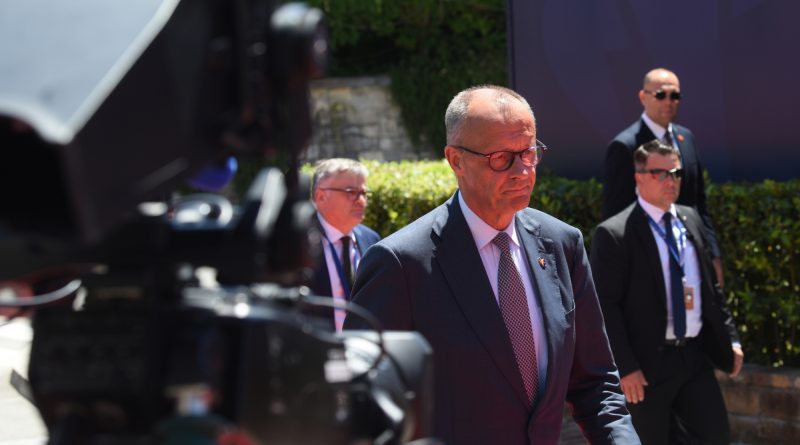
Merz Calls on EU to Prove Its Readiness for Expansion After 13 Years Without New Members
German Chancellor Friedrich Merz has issued a strong call for the European Union to demonstrate both its capability and willingness to welcome new member states, highlighting the bloc’s prolonged period without expansion. Speaking on the matter, Merz emphasized that the EU has not admitted any new countries for thirteen years, a stagnation he views as problematic for the union’s credibility and its relationships with aspiring members across Europe.
The German leader’s comments come at a pivotal moment for European geopolitics, as several Western Balkan nations and other candidate countries continue their long journeys toward EU membership. Croatia was the last country to join the bloc in 2013, and since then, the enlargement process has effectively stalled despite ongoing negotiations with multiple candidates. This extended pause has raised questions about the EU’s commitment to its founding principle of building an ever-closer union across the continent.
The current list of EU candidate countries includes Turkey, Montenegro, Serbia, Albania, North Macedonia, Ukraine, Moldova, Bosnia and Herzegovina, and Georgia. Each of these nations faces its own unique set of challenges in meeting the Copenhagen criteria, which require stable democratic institutions, a functioning market economy, and the ability to implement EU laws and regulations. For some candidates, such as Turkey, the accession process has been ongoing for decades with little visible progress, creating frustration and skepticism about the EU’s genuine intentions.
Merz’s statement reflects growing recognition within European leadership that the enlargement freeze has created a vacuum that other powers, particularly Russia and China, have sought to fill. In the Western Balkans especially, where EU membership has long been dangled as the ultimate goal, Chinese investment and Russian political influence have expanded significantly during the years of European indecision. This geopolitical competition has added urgency to discussions about whether the EU can afford to continue its cautious approach to expansion.
The war in Ukraine has fundamentally reshaped the enlargement debate within European institutions. Ukraine and Moldova received candidate status in June 2022, marking the fastest such decision in EU history and signaling a dramatic shift in political will. This accelerated process for Ukraine has renewed hope among other aspiring members while simultaneously raising concerns about the fairness and consistency of the accession criteria. Some longtime candidates have expressed frustration that their years of reform efforts seem to have been overlooked in favor of geopolitical considerations.
Germany, as the EU’s largest economy and most populous member state, holds considerable influence over the bloc’s direction. Merz’s advocacy for renewed enlargement efforts represents a significant policy position that could help shape the union’s approach in coming years. However, internal EU dynamics complicate any expansion efforts, as some member states have expressed concerns about absorbing new members before resolving existing institutional challenges. The unanimity requirement for admitting new members means that even a single country’s opposition can halt the process entirely.
Beyond political will, practical questions about EU institutional capacity for expansion remain unresolved. The current voting systems, budget allocation mechanisms, and representation structures were designed for a smaller union and have already been strained by previous enlargement waves. Many experts argue that significant internal reforms would be necessary before the bloc could effectively integrate additional members without becoming unwieldy or dysfunctional. These technical considerations often serve as convenient justifications for countries reluctant to embrace expansion for other reasons.
The implications of Merz’s call extend beyond immediate policy discussions to fundamental questions about European identity and the continent’s future architecture. For supporters of enlargement, the EU’s transformative power remains its greatest foreign policy tool, capable of stabilizing neighboring regions and spreading democratic values. For skeptics, further expansion risks diluting the union’s effectiveness and importing instability. As debates continue, the thirteen-year gap without new members stands as a stark reminder that the European project’s promise of unity and expansion has encountered significant obstacles in the twenty-first century.