
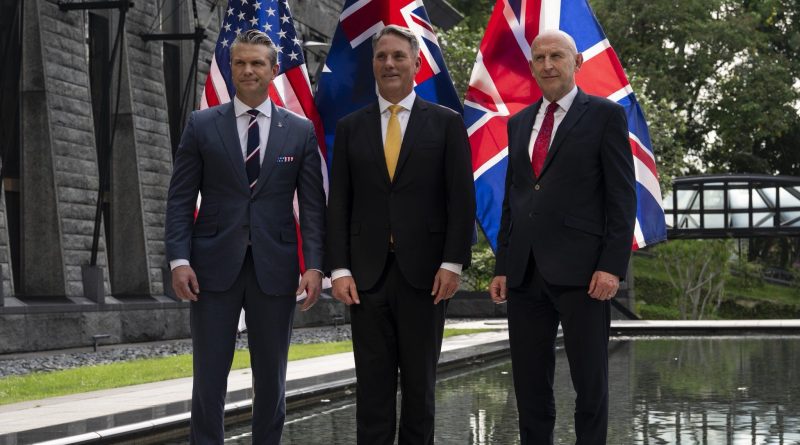
United States, Australia, and United Kingdom Join Forces to Modernize Underwater Drones Under AUKUS Partnership
In a significant development for trilateral defense cooperation, the defense ministers of the United States, Australia, and the United Kingdom have announced a groundbreaking joint project focused on the modernization and development of advanced underwater drone technology. This collaborative initiative falls under the framework of the AUKUS security pact, marking another milestone in the alliance’s efforts to strengthen collective maritime capabilities in an era of increasing geopolitical tension in the Indo-Pacific region.
The announcement underscores the growing importance of unmanned underwater vehicles (UUVs) in modern naval warfare and surveillance operations. These sophisticated autonomous systems have become increasingly crucial for a wide range of military applications, including intelligence gathering, mine detection, anti-submarine warfare, and reconnaissance missions in contested waters. By pooling their technological expertise and resources, the three nations aim to develop next-generation systems that could significantly enhance their strategic advantages beneath the ocean’s surface.
The AUKUS partnership, established in September 2021, represents one of the most ambitious defense collaborations in recent history. Originally conceived primarily around Australia’s acquisition of nuclear-powered submarines with American and British assistance, the alliance has since expanded its scope to encompass a broader range of advanced military technologies. The pact is structured around two main pillars: the submarine program and what officials describe as ‘advanced capabilities,’ which includes artificial intelligence, quantum computing, hypersonic weapons, electronic warfare, and now, significantly, underwater autonomous systems.
The decision to focus on underwater drone technology reflects the changing nature of naval warfare in the 21st century. Traditional surface vessels and manned submarines, while still essential, are increasingly complemented by unmanned systems that can operate in dangerous environments without risking human lives. Modern UUVs can remain submerged for extended periods, navigate autonomously using advanced algorithms, and perform tasks that would be too risky or impractical for crewed vessels. Military analysts suggest that whoever masters this technology will hold a decisive advantage in future maritime conflicts.
The strategic context for this collaboration cannot be overlooked. China’s rapid naval expansion and its assertive posture in the South China Sea and broader Indo-Pacific region have prompted Western allies to strengthen their military cooperation. Beijing has invested heavily in its own underwater capabilities, including advanced submarines and autonomous underwater vehicles, creating what defense experts describe as a potential ‘undersea arms race.’ The AUKUS nations view their collaboration as essential to maintaining deterrence and ensuring freedom of navigation in international waters that are vital to global trade routes.
Australia’s participation in this project is particularly noteworthy given its geographic position at the crossroads of the Indian and Pacific Oceans. Canberra has increasingly positioned itself as a key player in regional security architecture, investing billions of dollars in defense modernization. The country’s vast coastline and extensive exclusive economic zone make underwater surveillance capabilities especially valuable. For the United Kingdom, the project represents its commitment to the ‘Global Britain’ strategy, maintaining influence in the Indo-Pacific despite geographic distance. The United States, meanwhile, continues its role as the primary security guarantor in the region, seeking to integrate allied capabilities into a more cohesive defensive network.
Technical aspects of the underwater drone modernization program remain largely classified, though officials have indicated that the initiative will leverage cutting-edge developments in artificial intelligence, advanced materials, battery technology, and secure communications systems. The integration of AI is considered particularly crucial, as it enables these vehicles to make autonomous decisions in environments where communication with surface operators is limited or impossible. Previous collaborative efforts under AUKUS have demonstrated that combining the industrial bases and research institutions of all three countries can accelerate technological development significantly.
Defense industry observers note that this announcement could have substantial implications for private sector contractors in all three nations, potentially generating significant investment in research and development facilities. The project also raises important questions about international law, ethics of autonomous weapons systems, and the governance of military AI—issues that continue to be debated in forums ranging from the United Nations to academic institutions worldwide. As the AUKUS partners move forward with their underwater drone initiative, the international community will be watching closely to see how this collaboration shapes the future of maritime security and the broader global order.