
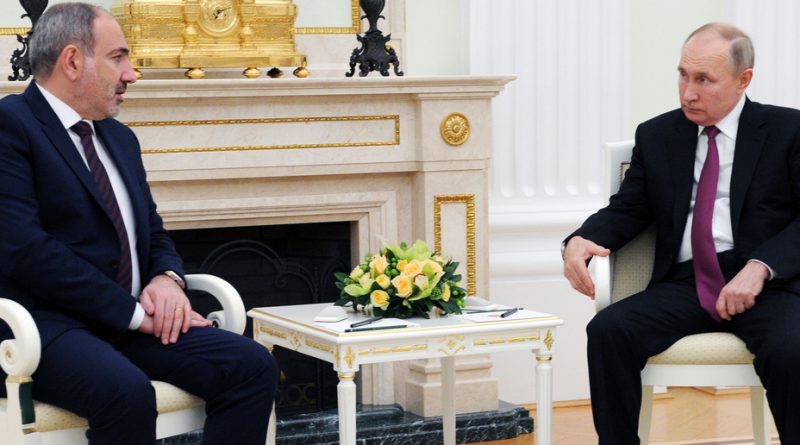
Russia Recalls Ambassador from Armenia for Consultations Amid Rising Tensions, Putin Hints at Ukraine Scenario
In a significant diplomatic escalation, Russia has recalled its ambassador from Armenia for consultations, a move that traditionally signals deep dissatisfaction between nations. This development comes at a particularly sensitive time, just ahead of Armenia’s upcoming parliamentary elections scheduled for June 2025, raising concerns about potential Russian interference in the South Caucasus nation’s political future.
The timing of Moscow’s decision appears far from coincidental. Russian President Vladimir Putin has reportedly made veiled references to a potential “Ukraine scenario” for Armenia, suggesting that the country could face consequences similar to those experienced by Ukraine if it continues to distance itself from Russian influence. Such rhetoric echoes the justifications Moscow used before its full-scale invasion of Ukraine in February 2022, when the Kremlin accused Kyiv of moving too close to Western institutions and NATO.
Relations between Moscow and Yerevan have deteriorated significantly since the 2020 Nagorno-Karabakh war, when Russian peacekeepers were deployed to the region but failed to prevent Azerbaijan’s military advances. The situation worsened dramatically in September 2023 when Azerbaijan launched a lightning offensive that resulted in the complete capture of the Armenian-populated enclave, leading to the exodus of approximately 120,000 ethnic Armenians. Many in Armenia blamed Russia for failing to fulfill its security commitments under the Collective Security Treaty Organization (CSTO), of which Armenia has been a member since 1992.
Armenian Prime Minister Nikol Pashinyan has increasingly pivoted toward the West in recent years, a shift that has infuriated the Kremlin. Armenia has frozen its participation in the CSTO, conducted joint military exercises with the United States, and expressed interest in closer ties with the European Union. In February 2024, Pashinyan publicly stated that relying on Russia for security was a “strategic mistake,” a remarkable statement from a leader of a country that has historically been one of Moscow’s closest allies in the post-Soviet space.
The recall of ambassadors for consultations is a well-established diplomatic tool that countries use to express serious displeasure without completely severing ties. In Russia’s diplomatic playbook, this measure has often preceded more aggressive actions or served as a pressure tactic during critical political moments. Analysts note that Moscow has historically attempted to influence elections in former Soviet states, using a combination of economic pressure, information warfare, and diplomatic intimidation to support pro-Russian candidates or destabilize governments perceived as unfriendly.
The upcoming Armenian elections represent a crucial moment for the country’s geopolitical orientation. Pashinyan’s Civil Contract party currently holds a parliamentary majority, but faces criticism both from pro-Western opposition forces who believe he has not moved quickly enough toward Europe, and from pro-Russian factions who argue that abandoning Moscow leaves Armenia vulnerable. Russia’s aggressive diplomatic posture ahead of these elections suggests that the Kremlin views the vote as a potential turning point that could either restore Russian influence or permanently push Armenia into the Western camp.
Historical precedent offers concerning parallels. Before Ukraine’s Euromaidan revolution in 2014 and the subsequent Russian annexation of Crimea, Moscow employed similar tactics of diplomatic pressure combined with ominous warnings about consequences for choosing Western integration over Russian partnership. The mention of a “Ukraine scenario” by Putin serves as both a threat and a reminder that Russia has demonstrated willingness to use military force against former Soviet republics that it perceives as drifting from its sphere of influence.
For Armenia, a landlocked nation bordered by Turkey and Azerbaijan — both of which have complicated or hostile relations with Yerevan — the geopolitical calculus remains extraordinarily complex. While many Armenians feel betrayed by Russia’s failure to protect Nagorno-Karabakh, the country’s security situation makes any dramatic realignment risky. As the election approaches, Armenian voters face a historic choice about their nation’s future orientation, while Moscow’s actions suggest the Kremlin will not accept any outcome that further diminishes Russian influence in the region without significant resistance.