
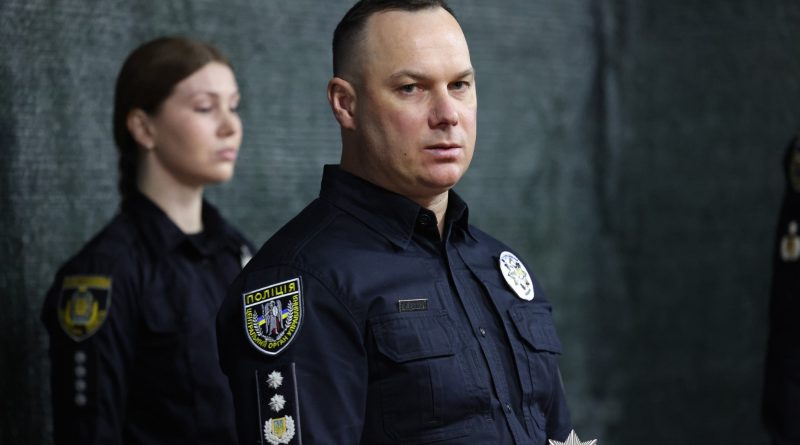
National Police Chief Does Not Rule Out Recruitment of Holosiivskyi Shooter, But Says It ‘Doesn’t Look Like It’
The head of Ukraine’s National Police, Ivan Vyhovsky, has addressed the ongoing investigation into the Holosiivskyi district shooting incident that shocked the nation, stating that while authorities cannot completely rule out the possibility that the shooter was recruited by hostile forces, current evidence does not support this theory. The investigation continues to examine all possible motives behind the tragic event that has raised serious questions about security and mental health support in wartime Ukraine.
During his public statement, Vyhovsky provided new details about the shooter’s background, revealing a history of conflicts with neighbors in the residential area where the incident occurred. According to police findings, the perpetrator had been involved in multiple disputes with those living nearby, suggesting a pattern of social friction that may have contributed to the eventual violence. The National Police chief indicated that investigators are carefully examining whether these ongoing tensions reached a breaking point, causing the individual to “snap” under accumulated pressure.
The possibility of foreign recruitment, while not dismissed entirely, appears increasingly unlikely based on the evidence gathered so far. Ukrainian security services have been on high alert for Russian attempts to recruit individuals within Ukraine to carry out acts of sabotage or terrorism, particularly since the full-scale invasion began in February 2022. Such recruitment efforts have been documented throughout the conflict, with Russian intelligence services targeting vulnerable individuals through various means including financial incentives, blackmail, or ideological manipulation. However, Vyhovsky emphasized that the current case does not exhibit the typical hallmarks of such operations.
The Holosiivskyi district, located in the southern part of Kyiv, is a densely populated residential area that has seen significant development in recent decades. Like many Ukrainian urban neighborhoods, it combines Soviet-era apartment blocks with newer construction, housing a diverse population of families, young professionals, and elderly residents. The shooting has sent shockwaves through the local community, prompting discussions about neighborhood safety and the availability of conflict resolution mechanisms for civilian disputes.
Mental health experts have long warned about the psychological toll of prolonged warfare on civilian populations. Since the beginning of Russia’s full-scale invasion, Ukrainians have faced constant stress from air raids, displacement, economic hardship, and the loss of loved ones. Studies conducted by Ukrainian and international health organizations have documented significant increases in anxiety, depression, and post-traumatic stress disorder among the population. While it remains unclear whether war-related stress played a role in this particular incident, the case has reignited discussions about the need for expanded mental health services and early intervention programs across the country.
Law enforcement officials have emphasized that the investigation remains active and that all leads are being pursued thoroughly. The National Police have deployed additional resources to reconstruct the timeline of events leading up to the shooting and to interview witnesses who may have observed warning signs. Forensic teams are analyzing physical evidence from the scene, while digital investigators are examining the shooter’s online activity and communications for any indications of radicalization or outside influence.
The incident has also prompted renewed debate among Ukrainian lawmakers about gun control measures and the screening processes for firearm ownership. While Ukraine has historically maintained relatively strict regulations on civilian weapon possession, the war has complicated enforcement and introduced large quantities of weapons into civilian areas. Some politicians have called for enhanced background checks and psychological evaluations for gun owners, while others argue that citizens need access to means of self-defense during wartime. As the investigation into the Holosiivskyi shooting continues, its findings may well influence future policy decisions on these contentious issues.