
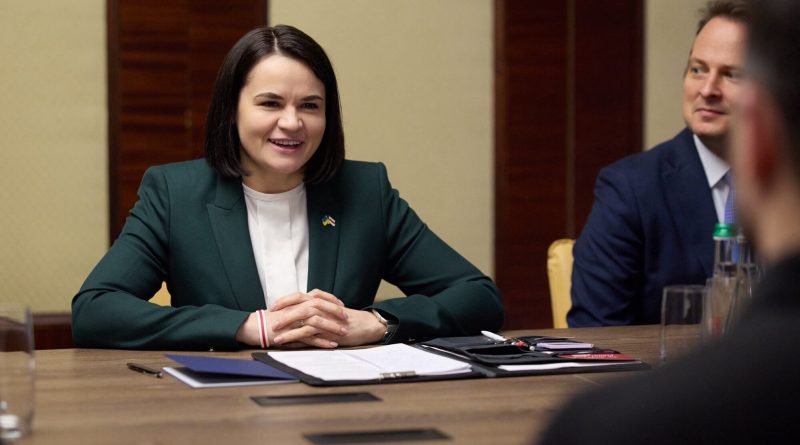
Lifting Restrictions for Belarusians in Ukraine Would Help Recruit Them to Armed Forces, Says Tsikhanouskaya
Belarusian opposition leader Sviatlana Tsikhanouskaya has called for Ukraine to ease restrictions on Belarusian citizens residing in the country, arguing that such measures would facilitate their recruitment into the Ukrainian Armed Forces. The prominent political figure, who has been living in exile since the disputed 2020 presidential election in Belarus, highlighted the significant difficulties that Belarusian nationals currently face when attempting to legalize their status in Ukraine.
Tsikhanouskaya’s statement comes amid ongoing tensions between Ukraine and Belarus, which has been a close ally of Russia throughout the full-scale invasion. Since February 2022, Ukrainian authorities have implemented strict security measures regarding citizens of both Russia and Belarus, treating them with heightened scrutiny due to concerns about potential security threats. These restrictions have made it increasingly challenging for Belarusians to obtain residency permits, open bank accounts, or access basic services in Ukraine.
The Belarusian opposition leader emphasized that many of her compatriots oppose the Lukashenko regime and genuinely support Ukraine’s fight for sovereignty. She pointed out that thousands of Belarusians have already demonstrated their commitment to Ukrainian independence by joining volunteer battalions and providing intelligence assistance. The most notable example is the Kastuś Kalinoŭski Regiment, a Belarusian volunteer military unit that has been fighting alongside Ukrainian forces since the early days of the invasion. Named after a 19th-century Belarusian revolutionary, the regiment has become a symbol of Belarusian resistance against Russian imperialism.
Historical context provides important background for understanding the complex relationship between Belarus and Ukraine. Both nations share Slavic heritage and were part of the Soviet Union until its collapse in 1991. However, their political trajectories diverged significantly, with Belarus under Alexander Lukashenko becoming increasingly authoritarian and aligned with Moscow, while Ukraine pursued closer ties with the European Union. The 2020 Belarusian presidential election, widely regarded as fraudulent by international observers, sparked massive protests that were brutally suppressed by Lukashenko’s security forces, forcing many opposition figures including Tsikhanouskaya to flee abroad.
According to various estimates, between 100,000 and 200,000 Belarusian citizens were living in Ukraine before the full-scale invasion began. Many of these individuals were political refugees who had fled persecution following the 2020 protests, while others had relocated for economic opportunities or family reasons. The outbreak of war created a paradoxical situation where these people, many of whom actively opposed Lukashenko’s regime and its support for Russia’s aggression, found themselves subject to the same restrictions as citizens of an enemy state.
Military experts suggest that recruiting motivated Belarusians could provide Ukraine with valuable human resources. These individuals often possess knowledge of Russian military tactics, speak Russian fluently, and have strong ideological motivation to fight against the regime that forced them from their homeland. Furthermore, their participation in the conflict serves a symbolic purpose, demonstrating that resistance to authoritarianism transcends national boundaries. The Kastuś Kalinoŭski Regiment has reportedly grown to include several thousand fighters, though exact numbers remain classified for security reasons.
Tsikhanouskaya has been working tirelessly from her base in Vilnius, Lithuania, to maintain international pressure on the Lukashenko regime while simultaneously advocating for the interests of Belarusians in exile. Her diplomatic efforts have included meetings with world leaders, testimony before international bodies, and coordination with other opposition figures. She has consistently argued that the Belarusian people should not be conflated with their government’s actions, and that supporting democratic Belarusians ultimately serves Ukraine’s strategic interests by weakening Lukashenko’s grip on power.
Ukrainian officials have not yet formally responded to Tsikhanouskaya’s latest appeal, though some parliamentarians have previously expressed support for differentiating between pro-democratic Belarusians and supporters of the Lukashenko regime. The question of how to handle Belarusian citizens remains politically sensitive in Ukraine, where public opinion toward Belarus has understandably soured following its role in facilitating the Russian invasion. Nevertheless, Tsikhanouskaya’s proposal presents a pragmatic argument that balancing security concerns with targeted recruitment could benefit Ukraine’s defense capabilities while strengthening ties with the Belarusian democratic movement.