
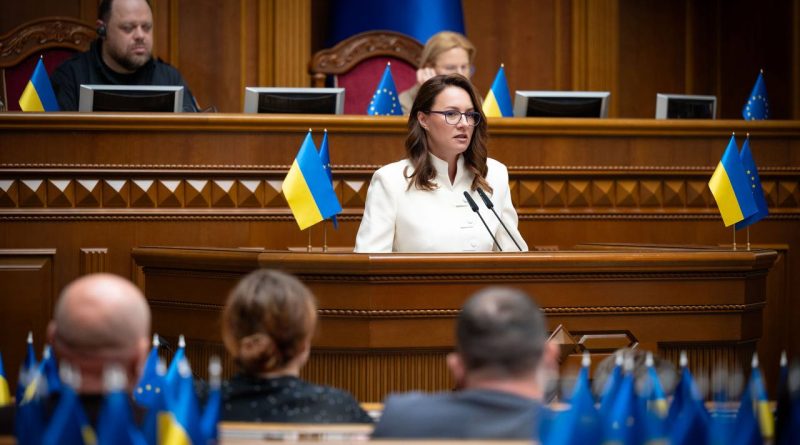
Ukrainian Cabinet of Ministers Under Svyrydenko Resigns After Less Than One Year in Office
In a significant political development, Ukraine’s parliament, the Verkhovna Rada, has voted to dismiss the Cabinet of Ministers led by First Deputy Prime Minister and Acting Prime Minister Yulia Svyrydenko. The resignation was supported by 258 members of parliament, marking the end of a government that had been in office for less than twelve months. This unexpected political shift comes at a critical time for Ukraine as the nation continues to navigate the ongoing challenges of war, economic reconstruction, and international diplomacy.
The dismissal of the Svyrydenko-led government represents one of the shortest tenures for a Ukrainian cabinet in recent history. Yulia Svyrydenko, who had previously served as Minister of Economy and held the position of First Deputy Prime Minister, stepped into the acting leadership role during a period of intense political and military pressure on the country. Her government was tasked with managing wartime economic policies, coordinating international aid, and implementing crucial reforms demanded by Ukraine’s Western partners and international financial institutions.
The vote threshold of 258 deputies exceeds the simple majority of 226 votes required in the 450-seat parliament, indicating substantial cross-party support for the government’s removal. Political analysts suggest that the decision reflects growing tensions within Ukraine’s ruling coalition and mounting criticism over the pace of reforms, economic management, and the handling of various domestic challenges during wartime. The resignation opens a period of uncertainty as President Volodymyr Zelensky must now nominate a new prime minister and cabinet for parliamentary approval.
Ukraine’s government structure has undergone significant changes since the full-scale Russian invasion began in February 2022. The country has operated under martial law, which grants the executive branch expanded powers but also places enormous responsibility on the cabinet to maintain economic stability and public services under extraordinary circumstances. Previous governments have faced similar pressures, with cabinet reshuffles becoming relatively common as the administration seeks to optimize its wartime governance and respond to evolving challenges on multiple fronts.
Yulia Svyrydenko, an economist by training, had been widely regarded as a key figure in Ukraine’s economic diplomacy. She played a central role in negotiations with the International Monetary Fund, the World Bank, and various bilateral donors who have provided essential financial support to keep Ukraine’s economy functioning during the war. Under her leadership, the government worked to implement structural reforms, combat corruption, and maintain macroeconomic stability despite the massive costs of the conflict, including destroyed infrastructure, displaced populations, and disrupted trade routes.
The timing of the government’s dismissal raises questions about the continuity of Ukraine’s reform agenda and its implications for the country’s European Union membership aspirations. In December 2023, EU leaders agreed to open accession negotiations with Ukraine, a historic decision that requires Kyiv to demonstrate continued progress on judicial reforms, anti-corruption measures, and the rule of law. International observers will be closely watching whether the incoming government maintains the reform momentum or if political instability leads to delays in meeting EU benchmarks.
As Ukraine enters this transitional period, the country faces the dual challenge of maintaining its defense capabilities while ensuring effective governance. The new cabinet will need to address pressing issues including energy infrastructure protection ahead of another potential winter of Russian attacks, managing the flow of international military and humanitarian assistance, and preparing for potential peace negotiations while the conflict continues. The speed with which President Zelensky nominates a successor and assembles a new government team will be closely monitored by Ukraine’s allies, who have emphasized the importance of stable governance for continued international support.