
EU to Open First Round of Accession Negotiations with Ukraine: A Historic Milestone on the Path to European Integration
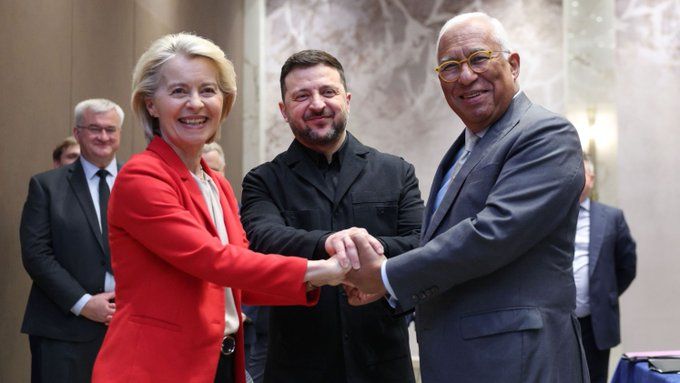
The European Union is set to take a momentous step in its relationship with Ukraine by opening the first round of accession negotiations during a conference scheduled for June 15. This landmark event will focus on the foundational negotiating chapter dedicated to democracy and the rule of law, marking the beginning of what promises to be a lengthy but transformative journey toward full EU membership for the war-torn nation. Ukrainian President Volodymyr Zelensky responded to the announcement with evident enthusiasm, calling it a significant achievement for his country’s European aspirations.
The decision to commence formal negotiations represents the culmination of years of diplomatic efforts and political reforms undertaken by Kyiv. Ukraine first signed an Association Agreement with the EU in 2014, following the Maidan Revolution that ousted pro-Russian President Viktor Yanukovych. The country officially applied for EU membership just days after Russia launched its full-scale invasion in February 2022, and was granted candidate status in June of that year—a process that typically takes years but was accelerated due to the extraordinary circumstances of the conflict.
The first negotiating cluster, known as the “Fundamentals” chapter, covers critical areas including the functioning of democratic institutions, judicial reform, anti-corruption measures, fundamental rights, and media freedom. This chapter is traditionally opened first and closed last in the accession process, as it forms the backbone of EU membership requirements. Brussels has emphasized that progress in this area will determine the overall pace of negotiations, sending a clear signal that Ukraine must continue its reform trajectory despite the challenges posed by the ongoing war.
The path to EU membership is notoriously complex and time-consuming. Previous enlargements have shown that negotiations can span anywhere from four to fifteen years, depending on the candidate country’s starting point and political will. Croatia, which joined in 2013, completed the process in about eight years, while Turkey’s negotiations, opened in 2005, remain incomplete nearly two decades later. For Ukraine, the timeline will depend heavily on the country’s ability to implement comprehensive reforms while simultaneously defending itself against Russian aggression—an unprecedented challenge in EU enlargement history.
President Zelensky has consistently framed EU membership as both a security guarantee and an economic lifeline for Ukraine’s future. In his reaction to the announcement, he emphasized that integration into European structures represents the fulfillment of the aspirations expressed by millions of Ukrainians during the Euromaidan protests and defended at great cost during the current war. The Ukrainian government has been working intensively on legislative reforms, including anti-corruption measures, judicial independence, and minority rights protections, to meet the EU’s stringent requirements.
The European Commission has outlined a series of benchmarks that Ukraine must meet before advancing through the various negotiating chapters. These include strengthening the independence of the Constitutional Court, reforming the selection process for judges, enhancing asset declaration systems for public officials, and ensuring the protection of national minorities—particularly regarding language rights. While Ukraine has made significant progress on several fronts, Brussels has noted that continued efforts are necessary, especially in combating entrenched corruption that has historically plagued the country’s institutions.
The geopolitical implications of Ukraine’s EU accession extend far beyond bilateral relations between Kyiv and Brussels. The move represents a fundamental reshaping of Europe’s security architecture and a clear rejection of Russian attempts to maintain a sphere of influence over its neighbors. EU officials have stressed that enlargement policy has been revitalized as a strategic tool, with the Western Balkans and Moldova also pursuing membership alongside Ukraine. As negotiations officially commence, the European project faces perhaps its most consequential expansion since the post-Cold War enlargements of 2004 and 2007, which brought former Soviet bloc nations into the union and transformed the continent’s political landscape.