
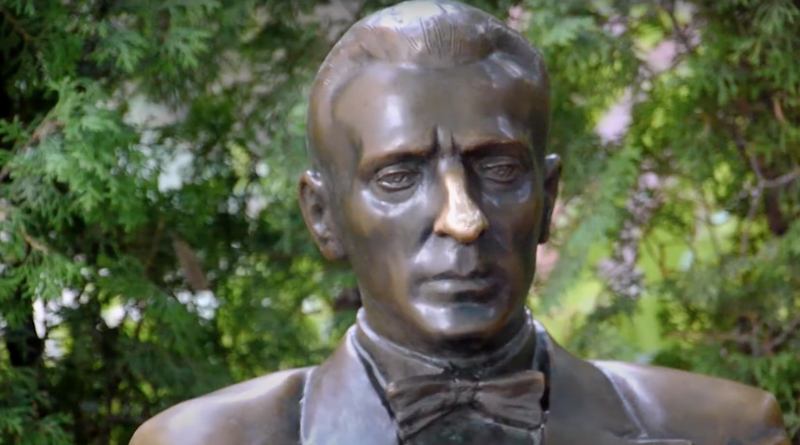
Historian Points to Uncomfortable Detail for Defenders of Bulgakov Monument in Kyiv
Ukrainian historian and journalist Vakhtang Kipiani has drawn attention to what he considers a revealing contradiction in the debate surrounding the recently demolished monument to writer Mikhail Bulgakov in Kyiv. According to Kipiani, those who have emerged to defend the monument were conspicuously absent before its removal, raising questions about the genuine nature of their attachment to the cultural landmark.
The controversy centers on the bronze statue that once stood on Andriyivsky Uzviz, one of Kyiv’s most historic streets where Bulgakov spent his formative years. Kipiani emphasized that prior to the demolition decision, opponents of removing the monument “were practically invisible.” This observation suggests that the sudden surge of defenders may be driven more by reactive sentiment than by sustained cultural advocacy. The historian’s remarks highlight the complex dynamics of memory politics in contemporary Ukraine, where Soviet-era cultural symbols have become increasingly contested.
Mikhail Bulgakov, born in Kyiv in 1891, remains a complicated figure in Ukrainian cultural discourse. While internationally celebrated for works such as “The Master and Margarita” and “Heart of a Dog,” his legacy in Ukraine is shadowed by his documented hostility toward Ukrainian language and culture. In his writings, particularly in “The White Guard,” Bulgakov depicted Ukrainian national aspirations dismissively and aligned himself firmly with Russian imperial perspectives. These views have made him a focal point for debates about which historical figures deserve public commemoration in independent Ukraine.
The removal of the Bulgakov monument is part of a broader decommunization and derussification effort that has accelerated dramatically since Russia’s full-scale invasion in February 2022. Ukrainian authorities have systematically renamed streets, dismantled monuments, and reevaluated cultural symbols associated with Russian imperial and Soviet narratives. This process, codified in legislation passed in 2015 and expanded in subsequent years, aims to reclaim Ukrainian public space from symbols perceived as representing colonial domination or foreign cultural hegemony.
Kipiani’s critique touches on a broader phenomenon observed in memory politics worldwide: the tendency for monuments to gain defenders only when faced with removal. Historians and sociologists have noted that public statues often fade into the background of daily urban life, rarely attracting sustained attention until their existence is threatened. This pattern raises important questions about the difference between genuine cultural heritage preservation and reflexive resistance to change. In Ukraine’s case, defenders of Russian cultural monuments must also contend with the ongoing military aggression from the country whose culture these monuments represent.
The debate over Bulgakov specifically illustrates the nuanced challenges facing Ukrainian cultural policy. Unlike straightforwardly political Soviet monuments, Bulgakov represents a literary figure whose works have artistic merit independent of his political views. However, supporters of the removal argue that public monuments are not primarily about artistic achievement but about whom a society chooses to honor in its shared spaces. They contend that Bulgakov’s anti-Ukrainian sentiments disqualify him from such recognition, regardless of his literary accomplishments, which remain accessible in libraries and bookstores.
The timing of the monument’s removal, during an active war with Russia, adds urgency to these cultural debates. Many Ukrainians view the derussification process as an essential component of national resilience, arguing that cultural sovereignty reinforces political and military resistance. Critics, including some international observers, worry about the potential loss of cultural complexity and the risk of applying present-day standards retroactively. Kipiani’s observation, however, suggests that local opposition to the removal was minimal until after the fact, indicating that the monument may have held less significance for Kyiv residents than the subsequent controversy implies.
As Ukraine continues to navigate the difficult terrain of wartime cultural policy, decisions about monuments like Bulgakov’s will likely remain contentious. The historian’s pointed remarks serve as a reminder that the loudest voices in heritage debates do not always represent longstanding community sentiment. Whether the removal of Bulgakov’s statue ultimately serves Ukrainian cultural development or creates new wounds in the nation’s complex historical memory remains a question that future generations will be better positioned to answer.