
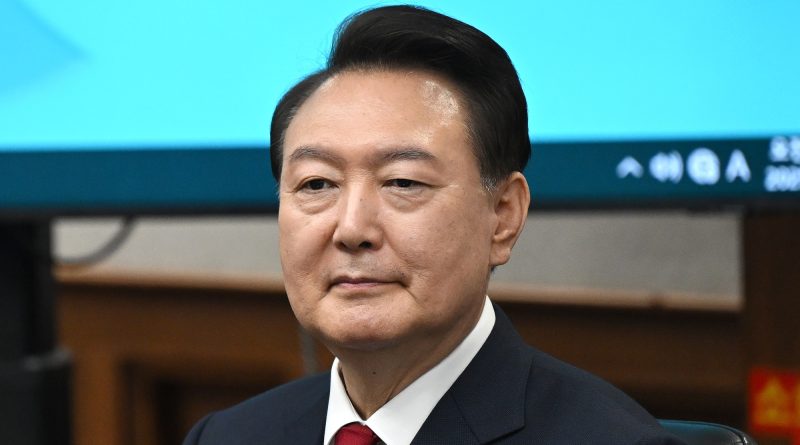
Former South Korean President Yoon Receives Additional 30-Year Prison Sentence in Martial Law Case
In a historic ruling that has sent shockwaves through South Korean politics, former President Yoon Suk-yeol has been sentenced to an additional 30 years in prison after being found guilty of aiding the enemy and abuse of power. The verdict, handed down by a Seoul court, marks one of the most severe punishments ever imposed on a former head of state in South Korea’s democratic history and adds to the growing list of South Korean presidents who have faced legal consequences after leaving office.
The charges stem from Yoon’s controversial declaration of martial law in December 2024, a decision that plunged the nation into political chaos and triggered mass protests across the country. Prosecutors argued that by deploying military forces against civilian institutions and attempting to suppress the National Assembly, Yoon fundamentally violated the constitutional order and endangered national security. The court found that his actions constituted not merely an abuse of presidential authority but rose to the level of betraying the nation’s democratic foundations.
The martial law declaration, which lasted only hours before being overturned by the National Assembly, represented the first such emergency measure in South Korea since the military dictatorship era ended in the late 1980s. Yoon justified the action by claiming threats from “anti-state forces,” but critics and legal experts widely condemned it as an unconstitutional power grab designed to circumvent legislative opposition to his administration’s policies. The incident immediately drew comparisons to the dark chapters of South Korean history, including the 1979 martial law declaration that followed President Park Chung-hee’s assassination and the subsequent military coup.
South Korea’s tumultuous relationship with presidential accountability has created a unique pattern in the nation’s political landscape. Since democratization in 1987, nearly every former president has faced criminal prosecution, imprisonment, or tragic endings. Park Geun-hye, Yoon’s predecessor from the conservative camp, was impeached in 2017 and subsequently sentenced to over 20 years in prison for corruption and abuse of power, though she was later pardoned. Lee Myung-bak served time for embezzlement and bribery, while Roh Moo-hyun took his own life while under investigation. This pattern has led scholars to examine whether the problem lies with individual leaders or with systemic issues in how presidential power is structured and checked in South Korean democracy.
The 30-year sentence adds to previous legal troubles facing the disgraced former president, who was already facing separate charges related to the martial law incident. Legal analysts note that the severity of the sentence reflects the court’s view that Yoon’s actions posed an existential threat to democratic governance. The “aiding the enemy” charge, typically reserved for cases involving espionage or collaboration with hostile foreign powers, was applied here in an expanded interpretation suggesting that undermining constitutional order itself serves the interests of adversaries. This legal reasoning has sparked debate among constitutional scholars about the boundaries of such charges in domestic political contexts.
The case has deepened the political polarization that has characterized South Korean society in recent years. Supporters of the former president have staged counter-demonstrations, arguing that the prosecution is politically motivated and that Yoon was acting within his constitutional authority to protect national security. However, public opinion polls consistently show that a majority of South Koreans support holding Yoon accountable for what they view as an attempted coup. The ruling conservative People Power Party has distanced itself from its former standard-bearer, while the opposition Democratic Party has called for additional investigations into military officials and political allies who participated in implementing the martial law decree.
International observers and human rights organizations have been closely monitoring the proceedings, noting both the strength of South Korea’s democratic institutions in reversing the martial law declaration and the independence of its judiciary in prosecuting a former president. The United States, South Korea’s closest ally, has maintained a careful diplomatic stance, emphasizing the importance of rule of law while avoiding direct commentary on the domestic legal proceedings. The case is expected to be appealed to higher courts, potentially reaching South Korea’s Supreme Court, where the final determination of Yoon’s fate will be decided. Regardless of the ultimate outcome, the case has already become a defining moment in South Korean constitutional history and a stark warning about the limits of executive power in democratic societies.