
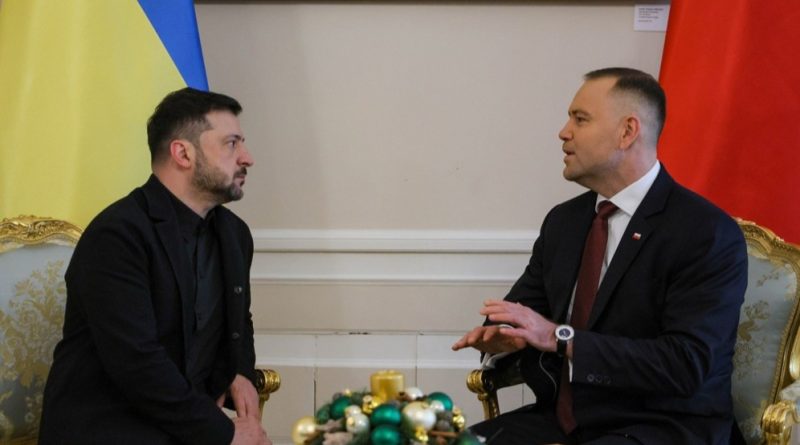
Ukraine-Poland Tensions: Zelensky and Nawrocki Hold Brief Exchange at NATO Summit Amid Diplomatic Standoff
Ukrainian President Volodymyr Zelensky and Polish President-elect Karol Nawrocki engaged in a brief conversation during the recent NATO summit, marking a significant moment amid ongoing diplomatic tensions between the two neighboring countries. The exchange, though short, comes at a critical juncture in Ukrainian-Polish relations, which have been strained by historical grievances and contemporary political disputes. Ukrainian Foreign Minister Andrii Sybiha has since outlined Kyiv’s official position regarding Warsaw, signaling Ukraine’s willingness to address outstanding issues while maintaining its strategic partnership with Poland.
The diplomatic friction between Ukraine and Poland has roots that extend far beyond the current conflict with Russia. Historical tensions center largely on the events of World War II, particularly the Volhynia massacre of 1943-1944, during which tens of thousands of Polish civilians were killed by the Ukrainian Insurgent Army (UPA). Poland has long demanded that Ukraine fully acknowledge these events as genocide and allow for the exhumation and proper burial of Polish victims on Ukrainian territory. These unresolved historical wounds have periodically resurfaced in bilateral relations, creating obstacles to full diplomatic normalization despite both countries sharing a common concern about Russian aggression.
Minister Sybiha’s articulation of Ukraine’s official stance represents a carefully calibrated diplomatic approach aimed at preserving the crucial strategic partnership with Poland while addressing Warsaw’s concerns. Ukraine has proposed a comprehensive dialogue framework that would address historical issues through joint historical commissions, academic exchanges, and mutual commemorative events. Kyiv has emphasized its readiness to facilitate the exhumation process for Polish victims, a key demand from Warsaw that has remained contentious for years. The Ukrainian government appears to be walking a delicate line between acknowledging Polish suffering and maintaining the historical narrative important to Ukrainian national identity.
The NATO summit provided an essential backdrop for this diplomatic interaction, as both countries recognize the paramount importance of Western unity in the face of Russian aggression. Poland has been one of Ukraine’s most steadfast supporters since the full-scale Russian invasion began in February 2022, serving as a primary transit hub for Western military aid and hosting millions of Ukrainian refugees. Warsaw has contributed significant military equipment, including tanks, howitzers, and fighter jets, making it one of the largest contributors to Ukraine’s defense relative to its GDP. This security cooperation has created a powerful incentive for both sides to manage their bilateral disputes without allowing them to undermine the broader strategic partnership.
Political analysts suggest that the brief Zelensky-Nawrocki exchange signals both the challenges and opportunities in the relationship. Nawrocki, who represents Poland’s Law and Justice party’s political tradition, has taken a harder line on historical issues compared to some of his predecessors. However, experts note that Poland’s security concerns regarding Russia create a natural alignment with Ukraine that transcends historical disagreements. The new Polish leadership must balance domestic political pressures, including demands from veterans’ groups and conservative constituencies for a firmer stance on historical recognition, with the strategic imperative of maintaining Ukrainian resistance to Russian expansion.
Ukraine’s diplomatic outreach also reflects a broader recognition that maintaining Western support requires addressing allies’ concerns proactively. As the war enters its fourth year, Ukraine faces increasing pressure to demonstrate its commitment to European values and reconciliation processes. The country’s bid for European Union membership adds another dimension to these discussions, as Brussels has emphasized the importance of regional cooperation and the resolution of bilateral disputes as part of the accession criteria. By offering concrete proposals on the exhumation issue and historical dialogue, Kyiv aims to demonstrate good faith while protecting its core interests.
The path forward for Ukrainian-Polish relations will likely require sustained diplomatic engagement at multiple levels. Both governments have established working groups to address specific issues, and civil society organizations in both countries have advocated for reconciliation initiatives that acknowledge multiple historical perspectives. The economic dimension of the relationship also plays a crucial role, as Poland serves as a vital economic partner for Ukraine and a gateway to European markets. As the war continues and reconstruction planning begins, the importance of a strong Ukrainian-Polish partnership will only grow, providing both nations with powerful incentives to find common ground on even the most sensitive historical questions while maintaining their united front against Russian aggression.