
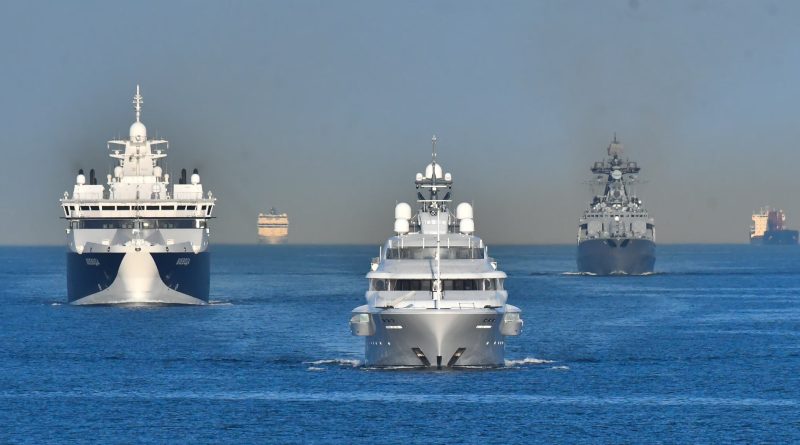
Putin’s Luxury Yacht Spotted Near Danish Waters: Vessel Reportedly Equipped with Anti-Drone Protective Netting
A luxury yacht believed to belong to Russian President Vladimir Putin has been observed sailing near Danish territorial waters, with maritime observers noting what appears to be newly installed anti-drone protective netting on multiple decks. The sighting has sparked widespread speculation about the reasons behind the vessel’s unusual movement and the enhanced security measures visible on the ship, with some analysts suggesting the relocation may be connected to increased Ukrainian drone strike activity targeting the St. Petersburg region in recent months.
The yacht in question is believed to be the “Graceful,” a 82-meter superyacht valued at approximately $100 million that has long been associated with the Russian president. Maritime tracking data and eyewitness accounts indicate the vessel was spotted transiting through waters near Denmark, a NATO member state, raising questions about its intended destination and the circumstances prompting its apparent relocation from Russian waters. Video footage circulating on social media appears to show distinctive mesh-like structures installed across the yacht’s upper decks, consistent with anti-drone defense systems that have become increasingly common on high-value maritime assets.
The timing of this movement is particularly significant given the escalating drone warfare campaign that has characterized the Russia-Ukraine conflict. Ukraine has demonstrated increasingly sophisticated capabilities in launching long-range drone strikes deep into Russian territory, with St. Petersburg and its surrounding areas experiencing multiple attacks in recent months. The historic city, Russia’s second-largest metropolitan area and a major naval hub, has seen its air defense systems repeatedly activated as Ukrainian unmanned aerial vehicles have targeted military installations, fuel depots, and strategic infrastructure throughout the region.
Anti-drone netting technology has emerged as a critical defensive measure in modern asymmetric warfare, designed to physically intercept and entangle small unmanned aerial vehicles before they can reach their intended targets. These systems, which resemble large mesh barriers, have been deployed extensively by Russian forces around sensitive military positions, government buildings, and critical infrastructure since the beginning of the Ukraine conflict. The apparent installation of such systems on a presidential yacht represents a notable acknowledgment of the drone threat’s reach and the vulnerability of high-profile assets, even those operating in what would traditionally be considered safe waters.
Putin’s relationship with luxury yachts has been a subject of considerable international attention and controversy. Western intelligence agencies and investigative journalists have long documented the Russian president’s access to a fleet of opulent vessels, despite his official salary being relatively modest by global standards. The Graceful, along with other suspected Putin-linked yachts such as the massive “Scheherazade,” have been subjects of sanctions discussions and asset-freezing efforts by Western governments seeking to pressure the Kremlin over its military actions in Ukraine. Several vessels allegedly connected to Russian oligarchs and government officials have been seized in European ports since 2022 as part of coordinated international sanctions packages.
The movement of the yacht through Danish waters also highlights the complex geopolitical dynamics of the Baltic Sea region, which has become an increasingly contested maritime space since the outbreak of the Ukraine war. Denmark, as a founding NATO member and guardian of the strategic straits connecting the Baltic to the North Sea, occupies a critical position in regional security architecture. The country has significantly increased its military spending and surveillance capabilities in response to perceived Russian threats, while also hosting NATO naval exercises designed to demonstrate alliance solidarity and deterrence capabilities in the region.
Maritime security experts note that the apparent relocation of high-value Russian assets away from areas vulnerable to drone strikes reflects a broader pattern of defensive repositioning observed since Ukraine began demonstrating its ability to strike targets deep within Russian territory. Similar movements have been reported involving Russian naval vessels, with some warships being relocated from traditional home ports to facilities deemed less exposed to Ukrainian attack capabilities. The visible installation of physical anti-drone defenses on a vessel associated with the Russian president sends a powerful symbolic message about the current threat environment and the challenges facing Russian security services in protecting key assets and individuals from the evolving drone warfare landscape.