
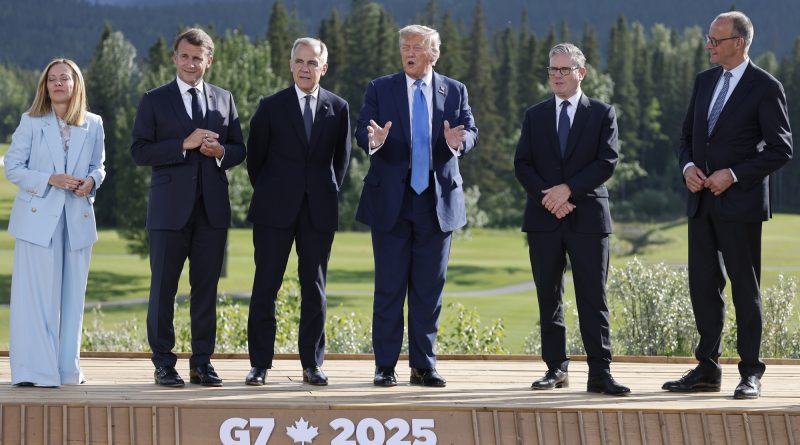
G7 Summit Seeks to Project Unity, But Ukraine and Iran May Derail Consensus
As world leaders prepare to gather for the annual Group of Seven summit, diplomatic sources have revealed that simply securing the attendance of all participants would already constitute a measure of success. The upcoming meeting, which brings together the leaders of the world’s most advanced economies, faces unprecedented challenges in maintaining the appearance of Western solidarity. According to Politico, one G7 diplomat candidly admitted that President Donald Trump’s mere presence at the summit would be considered an achievement, highlighting the fragile state of transatlantic relations and the difficulties in coordinating policy among traditional allies.
The G7, comprising the United States, Canada, France, Germany, Italy, Japan, and the United Kingdom, has historically served as a forum for coordinating economic policy and addressing global challenges. Established in 1975 as the G6 before Canada joined the following year, the group has weathered numerous crises and disagreements over its nearly five decades of existence. However, recent years have seen growing tensions within the alliance, particularly regarding trade policies, climate change commitments, and approaches to international security. The addition of the European Union as a non-enumerated member has further complicated discussions, as the bloc often advocates for positions that may differ from individual member states.
Ukraine remains one of the most divisive issues threatening to disrupt the summit’s unified messaging. Since Russia’s full-scale invasion in February 2022, Western nations have provided billions of dollars in military and economic assistance to Kyiv. However, the approaches to supporting Ukraine vary significantly among G7 members. While European nations, particularly those closer to Russia’s borders, have advocated for sustained long-term support, there have been growing debates about the pace and scope of military aid. The Trump administration’s approach to the conflict has introduced additional uncertainty, with discussions about potential diplomatic solutions that may not align with European perspectives or Ukrainian aspirations. The question of how to structure continued support while potentially exploring paths to negotiation has created visible fault lines within the alliance.
The situation in Iran presents another significant challenge to G7 cohesion. The Islamic Republic’s nuclear program has been a source of international concern for decades, with the 2015 Joint Comprehensive Plan of Action representing a rare moment of diplomatic consensus. However, the subsequent withdrawal of the United States from the agreement during Trump’s first term, followed by Iran’s gradual abandonment of its commitments, has left the international community without a clear framework for addressing Tehran’s nuclear ambitions. European members of the G7 have generally favored diplomatic engagement and the preservation of whatever remains of the nuclear deal, while the American position has oscillated between maximum pressure campaigns and various diplomatic overtures.
Beyond these immediate flashpoints, the summit must also navigate broader structural tensions within the Western alliance. Trade disputes, particularly regarding tariffs and industrial policy, have created friction between the United States and its partners. The European Union’s efforts to develop strategic autonomy in defense and technology have sometimes been viewed with skepticism in Washington. Meanwhile, Japan finds itself balancing its alliance with the United States against its complex economic relationships in Asia. These underlying tensions make it increasingly difficult to present the united front that G7 summits have traditionally aimed to project to the rest of the world, particularly to adversarial nations watching for signs of Western disunity.
Historical precedent offers mixed lessons for the current situation. Previous G7 summits have managed to paper over significant disagreements, producing carefully worded communiqués that allow each leader to claim success while maintaining alliance cohesion. The 2018 summit in Canada, however, demonstrated how quickly apparent consensus can collapse, when President Trump withdrew his endorsement of the joint statement shortly after the meeting concluded. That episode served as a warning about the fragility of diplomatic agreements and the importance of managing expectations. Diplomats involved in planning the current summit appear to have internalized these lessons, setting modest goals focused on maintaining dialogue rather than achieving breakthrough agreements.
As the summit approaches, the international community will be watching closely for signals about the health of the Western alliance. The ability of G7 leaders to find common ground on Ukraine and Iran will serve as a barometer for the broader state of transatlantic relations. Success may ultimately be measured not by sweeping declarations or ambitious initiatives, but by the simpler metric of whether the world’s leading democracies can still sit at the same table and engage in productive dialogue. In an era of rising geopolitical competition and increasing global instability, even this modest achievement would carry significant symbolic weight, demonstrating that despite their differences, Western nations remain committed to collective action and shared values.