
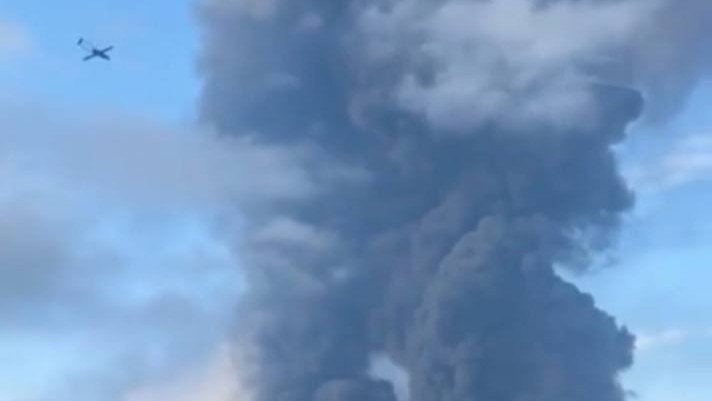
Ukraine Strikes Chemical Plant, Oil Facility as Drone Campaign Intensifies: Zelensky Reports New Attacks on Russian Territory
Ukrainian President Volodymyr Zelensky announced the results of a significant drone attack campaign against Russian territory on June 14, 2026, revealing successful strikes on the Azot chemical plant, an oil facility, and disruptions that forced the closure of six Russian airports. The announcement marks another escalation in Ukraine’s long-range strike capabilities as the conflict continues into its fifth year, with Kyiv increasingly taking the war to Russian soil in an effort to degrade Moscow’s military-industrial complex and economic infrastructure.
The Azot chemical enterprise, one of Russia’s major producers of nitrogen-based fertilizers and industrial chemicals, has been a strategic target due to its dual-use capabilities. Chemical plants like Azot produce ammonia and other compounds that have applications in both agricultural and military sectors, including the production of explosives and rocket propellants. The facility’s disruption represents a significant blow to Russia’s industrial capacity, though the full extent of the damage has not been independently verified. Russian authorities have not yet issued an official statement regarding casualties or the operational status of the plant following the attack.
The strike on an unspecified oil facility continues Ukraine’s systematic campaign against Russian energy infrastructure, which has intensified dramatically over the past two years. Since early 2024, Ukrainian forces have targeted refineries, oil depots, and fuel storage facilities across western Russia, aiming to disrupt the supply of petroleum products to Russian military forces and reduce Moscow’s oil export revenues. Energy analysts estimate that these attacks have reduced Russia’s refining capacity by approximately 15-20 percent at various points, forcing the Kremlin to implement fuel export restrictions and redirect resources to air defense systems protecting critical infrastructure.
The temporary closure of six Russian airports underscores the psychological and logistical impact of Ukraine’s drone warfare strategy. While specific airports affected were not named in Zelensky’s statement, such closures typically occur in regions within range of Ukrainian unmanned aerial vehicles, including areas around Moscow, Voronezh, Kursk, and other western Russian cities. These disruptions affect civilian air travel, cargo operations, and potentially military logistics, demonstrating that the effects of the conflict extend far beyond the front lines in eastern and southern Ukraine.
Ukraine’s drone program has evolved significantly since the early months of the war, transforming from a reliance on imported systems to a robust domestic production capability. Ukrainian manufacturers now produce thousands of long-range drones monthly, with some models capable of striking targets more than 1,000 kilometers from launch points. This indigenous production has been supplemented by Western technical assistance and components, allowing Ukraine to maintain a sustained tempo of operations despite Russian efforts to intercept incoming drones with air defense systems and electronic warfare countermeasures.
The strategic rationale behind Ukraine’s deep-strike campaign reflects a broader shift in military doctrine. Unable to match Russia’s advantages in artillery, aviation, and manpower along the front lines, Ukrainian commanders have sought to impose costs on Russia by targeting the economic and military infrastructure that sustains Moscow’s war effort. By striking chemical plants, refineries, military bases, and ammunition depots, Ukraine aims to degrade Russia’s capacity to wage a prolonged conflict while demonstrating to the Russian population that the war cannot be confined to Ukrainian territory alone. Western military analysts have noted that this approach mirrors historical examples of strategic bombing campaigns, adapted for the era of unmanned systems.
President Zelensky has consistently framed these attacks as legitimate acts of self-defense, arguing that Ukraine has every right to target facilities that contribute to the Russian military machine. The international community has largely refrained from condemning Ukrainian strikes on Russian territory, though some Western officials have privately expressed concerns about escalation risks. As the war enters its fifth year with no clear end in sight, both sides appear committed to strategies of attrition, with Ukraine betting that sustained pressure on Russian infrastructure will eventually shift the balance in its favor or compel Moscow to negotiate on more favorable terms.